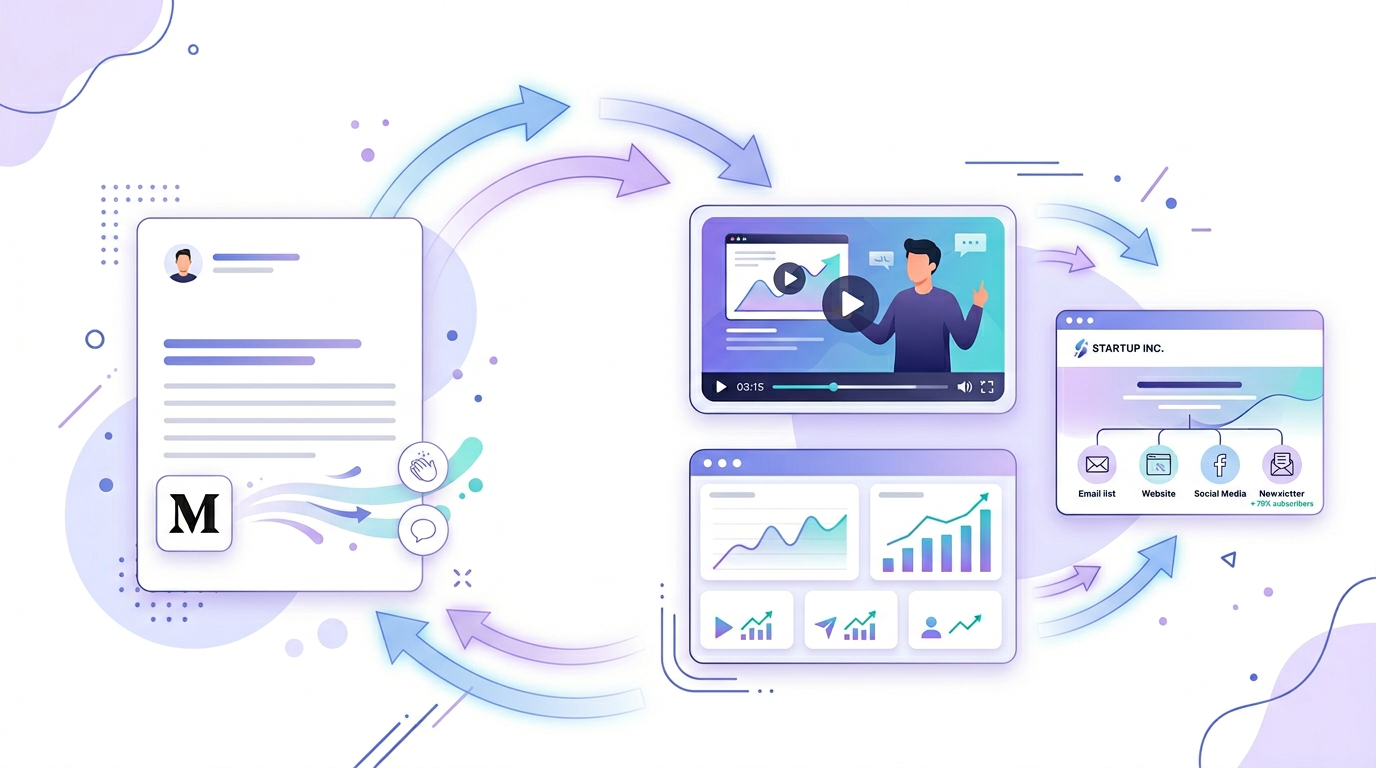
Channel strategy
Use Medium for awareness, then route attention back to owned channels
A Medium post can be the spark, but your site and product pages should still be where long-term value compounds.
Keep the site canonical
The safest long-term move is to treat the site as the SEO home and adapt the idea for Medium rather than relying on Medium as the permanent destination. Medium can create discovery, but it does not replace the value of building search equity and conversion paths on your own domain.
That means the source article should usually live on the site first. Medium then becomes a distribution layer that introduces the idea to a wider audience while still reinforcing your owned content strategy.
Use Medium for narrative framing
The site can be keyword-led. Medium should feel more story-driven. Readers on Medium respond well to a perspective, a sharp lesson, or a founder angle rather than a rigidly optimized landing-page structure.
That makes Medium a good place to reframe the same idea rather than duplicate it. You can lead with a mistake, insight, or behind-the-scenes moment and then connect readers back to the deeper canonical version on your site.
- Lead with a narrative or opinion that feels natural on Medium.
- Link back to the canonical site article where the full workflow lives.
- Use the video as proof that the concept is practical, not just theoretical.
Use video as the bridge back
When a Medium reader sees a video version tied to the same idea, that creates another reason to click through to the site or product. Video gives the topic a second format that feels native to sharing, embedding, and social distribution.
This is especially useful when the original post explains a workflow, tutorial, or product capability. The video acts as both a teaching asset and a conversion bridge because it lets readers see the concept operating in practice.
Adapt the workflow per channel
The strongest system is not publishing the exact same asset everywhere. It is preserving the same core insight while letting each channel do its own job. The site captures search, Medium captures serendipitous discovery, and the video makes the idea easier to consume quickly.
That kind of channel adaptation is what turns Medium from a side experiment into a useful part of a broader content engine.
How Blog2Video handles this
1. Paste your Medium post URL — Blog2Video reads the article directly from the published page and extracts the structure, images, and narrative flow.
2. Pick a template — Choose a visual style that matches your Medium brand, from polished Spotlight to conversational Whiteboard.
3. Generate and cross-post — Get a narrated video you can embed in the Medium story, share on LinkedIn, or upload to YouTube with a link back to the original.
Frequently Asked Questions
Who is this guide for around Medium to video?
It is designed for written-first creators and teams who already have source material and want a repeatable path into video rather than a prompt-only workflow.
Does this help with cross-channel creator workflows?
Yes. Each article is written to help you turn one content asset into multiple formats while keeping the original message intact.